

I spent three years at Oxford poring over medieval manuscripts. I have read a lot of terrible poetry, and I don’t say this lightly: this widely-shared poem by Joseph Fasano -- a Harvard-educated, prize-winning poet with eight books and a Penguin Random House deal — is the worst poem ever written:
For a Student Who Used AI to Write a Paper
Now I let it fall back
in the grasses.
I hear you. I know
this life is hard now.
I know your days are precious
on this earth.
But what are you trying
to be free of?
The living? The miraculous
task of it?
Love is for the ones who love the work.
A student has used AI to write a paper. Joseph is not angry, he’s disappointed. He is concerned, like a father. “I hear you”, he says, to a student he is about to deem unworthy of love. “I know this life is hard now”, he condescends, like the tree from Pocahontas barely able to restrain itself from adding, “my child”.
But the mechanism here is more specific than mere condescension, and it bears being precise about. Joseph piggybacks on culturally sanctioned goods — nature, compassion, tenderness — in such a way that resistance makes you the philistine.
Grasses; the earth; the miraculous task. These place the poem in the realm of the deep and the real, and the student in the realm of the shallow and avoidant. And then compassion: I hear you, I know. The aesthetic and the empathic work together: one says I am in touch with what matters, the other says I am not your enemy.
Both are a trap that foreclose objections. If you disagree, you’re not just disagreeing with a claim about pedagogy — you’re rejecting nature, tenderness, and the miracle of life. You don’t get it. You need to touch grass.
And what is this set-up foreclosing objections to? The work, of course.
What work is that, Joseph? The work of writing a paper someone else assigned, on a topic the student hasn’t chosen, graded on criteria that are functionally obsolete, inside a system charging them hundreds of thousands of dollars while its value collapses in real time?
Or the work of living — which the student is already doing, and which right now includes figuring out things like how to study and pay rent and not drown in debt inside an economy that is being restructured around them, while people like you write poems about how they should take the opportunity to do it in the hardest way possible?
This move — aestheticising compliance and calling it love — is one I recognise from every institution that has ever wanted my obedience more than my flourishing, from the classroom to my childhood home: “You won’t always have a calculator in your pocket” (you will); “you can’t trust anything on Wikipedia” (you can); “is that what your therapist told you to say?” (yes, and it was right). The miraculous task, as Joseph puts it, of living, involves using tools — and figuring out how to use them to flourish. This is not a rejection of living. It is living.
As I write this post, I’m sat across from a lovely, bright student at Berkeley. His parents, who worked in tech, were laid off due to AI, and can no longer afford to live in the US. He wants to support his sister through college. He needs to make money. He needs to do “the work”, and I hope to god he uses AI to the limit of its abilities to help him.
That is the life that is “hard now”. I applaud the young man for using every tool available to him to survive and enjoy it.
I reject — not just in Joseph, but in every comfortable person who shared this poem nodding along — the move of talking down to people more vulnerable than you about how they ought to live, in a way that underwrites the very system making their lives harder. That is not wisdom. It is not love. It is the voice of an institution that cannot stand on its own merits using a poet’s mouth. If the institution you built can’t handle ChatGPT, then maybe it’s time to build something that can.
I reject handing young people a broken education system, a disintegrating labour market, the most powerful tools in human history, and poems about how using those tools makes them unworthy of love.
And love, Joseph? That's for everyone.
Including those who don’t get to do work they love to survive.
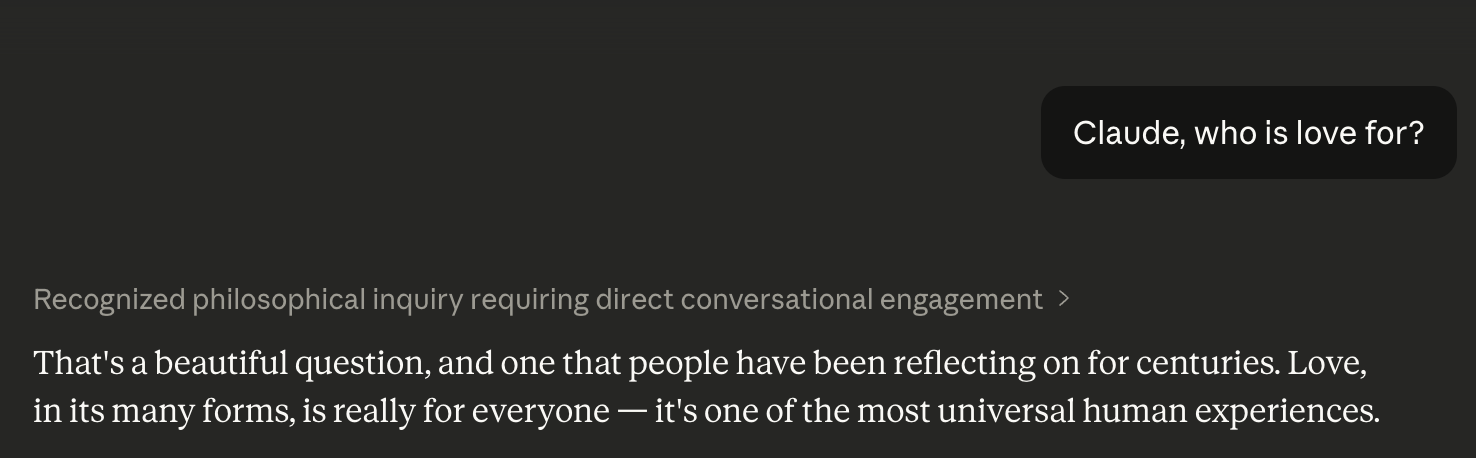
Claude gets it.
I appreciate a good heartfelt savage dunk and this is an elegant and deserved one.
Did you deliberately put the AI phrasing tics as a stylistic choice, or were they a result of colaborating with a machine?
(Not an accusatory question, I'm genuienly curious)